
Map the Hidden Connections Across Your Legal Knowledge
Interactive models turn flat document lists into living networks of cases, statutes, parties, and concepts. Trace how a legal principle evolves across decades, query your knowledge in structured or plain language, and surface the connections linear search leaves behind.
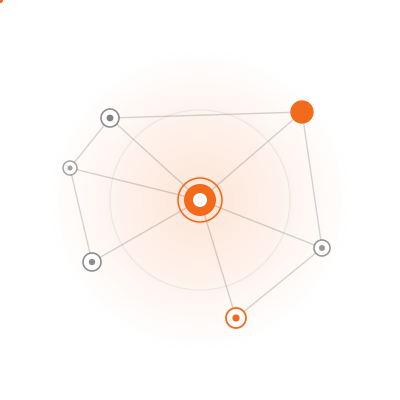
Legal Knowledge Is Connected. Your Tools Treat It as Isolated.
Legal reasoning is about connections: how cases cite each other, how statutes relate, how parties interact, and how principles evolve across jurisdictions and decades. Yet most legal databases present knowledge as flat lists of individual documents, leaving the relationships, the most valuable layer of intelligence, invisible. Missed connections cost litigators winnable arguments, hide conflict-of-interest risks between parties, and break compliance analyses that depend on statutory dependencies.
Tools for graph-powered legal intelligence
Graph Library
Build and query multiple knowledge graphs, each with its own entities, relationships, and sources. Focus one on a matter, a practice area, a regulatory domain, or the entire firm.
Entity Registry
A structured catalog of every person, organization, case, statute, document, and court in your graphs, each with properties, source documents, and status tracking.
Relationship Mapper
Define and discover links like cites, represents, supersedes, governs, and amends. Add custom, weighted, directional, and time-bound relationships, or let document analysis find them automatically.
Interactive Visual Explorer
Explore graphs on a node and link canvas where size signals importance and color signals type. Click any node to expand its neighborhood, then zoom, pan, and filter by type or time period.
Visual Query Builder
Compose path queries by choosing a source entity, a relationship, a target, and a hop limit, with a live Cypher-like preview. Run them in plain language and view results as tables or graphs.
Connected Data Ingestion
Pull from document stores, CRM systems, court records, email, regulatory feeds, and manual uploads. Map source fields to entities and set real-time, hourly, or daily sync schedules.
Graph Analytics
Measure density, average path length, and degree distribution to reveal hubs, detect communities, and flag isolated nodes that point to gaps in your data.
Conflict Network Mapping
Visualize party relationships across every matter to expose ties between current clients, former clients, opposing parties, and co-counsel that traditional conflict searches miss.
Temporal Graph Timeline
Trace how entities and relationships change over time, replaying when a precedent was cited, superseded, or amended so you can see how a legal principle moved across decades.
From raw documents to a living network
Connect your sources
Ingest from document stores, CRM systems, court records, email, regulatory feeds, and manual uploads. Map source fields to entities and set real-time, hourly, or daily sync schedules.
Build entities and relationships
Register persons, organizations, cases, statutes, documents, and courts, then define links like cites, represents, supersedes, and amends, or let document analysis discover them automatically.
Explore the network
Open the interactive canvas where node size signals importance and color signals type. Click any node to expand its neighborhood, then zoom, pan, and filter by entity type or time period.
Query and analyze
Compose path queries in plain language or a visual builder, then run graph analytics to surface hubs, detect communities, measure path length, and flag isolated nodes that point to data gaps.
Connects across the platform
- Research: citation networks enhance research discovery
- Litigation: case and party graphs inform strategy
- Compliance: regulatory dependency networks drive analysis
- Documents: entities populate from your document store
- Deposition: entities extracted from transcripts feed the graphs
- Virtual Courtroom: session transcripts generate entity data