What it recalls
Past reasoning, not just past files.
Prior arguments, fallback positions, preferred clauses, client-specific redlines, and the conditions under which those choices changed are stored as retrievable memory.
The Intelligence Layer
JudicialMind Intelligence is an AI legal research layer for law firms and in-house teams. It staffs specialist agents against your matters, runs case simulations, builds legal knowledge graphs, and preserves your firm's institutional memory. Every output is cited, reviewable, and requires human approval.
The premise
Every legal-tech product promises "AI." Most deliver a chatbot next to a document viewer. That's not how lawyers think. Legal work is a recursion of hypotheses, arguments, counter-arguments, authorities and rehearsal, refined under deadline pressure.
The Intelligence layer models that recursion. You don't prompt it. You staff it, brief it, stress-test your theory against it before opposing counsel does. Underneath the matter, pleading, or deal, a system of specialists, memory, and graphs does the work that used to take three associates and a weekend.
The bench
Each capability is a distinct kind of expertise. They compose: a simulation cites a knowledge graph, an agent consults institutional memory, a panel debates on the record of a specific matter. You pick the lineup; we run the play.
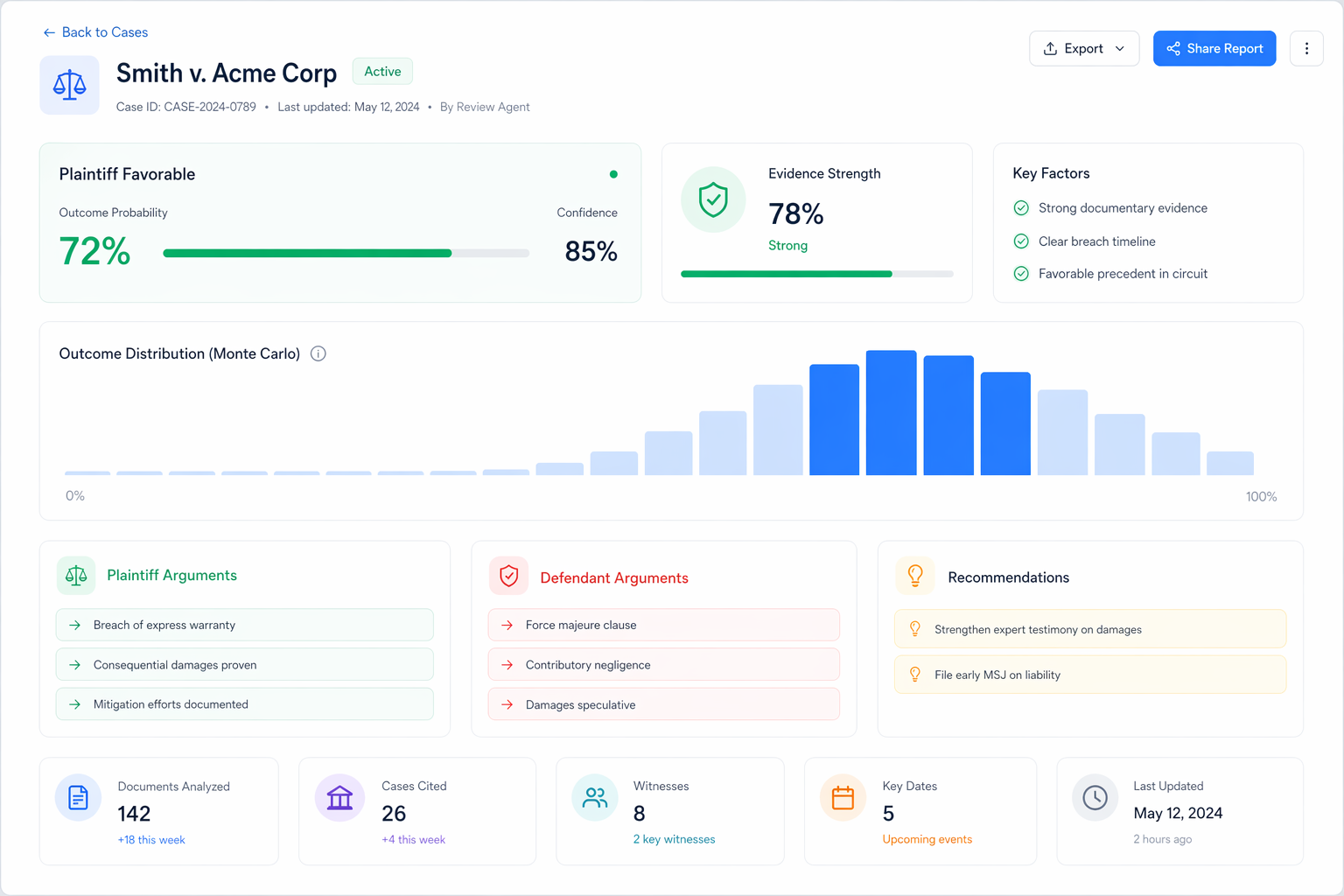
Feed in your theory of the case, the underlying record and the posture of the forum. Simulation runs it forward: opening, cross, redirect, the judge's likely interjections, the motions you'll face and the ruling bands you should expect.
Use it for oral argument prep, settlement posture, early case assessment, or to stress-test a novel position before you put your name on it. It won't tell you what the court will do. It will tell you what a well-prepared adversary will try.
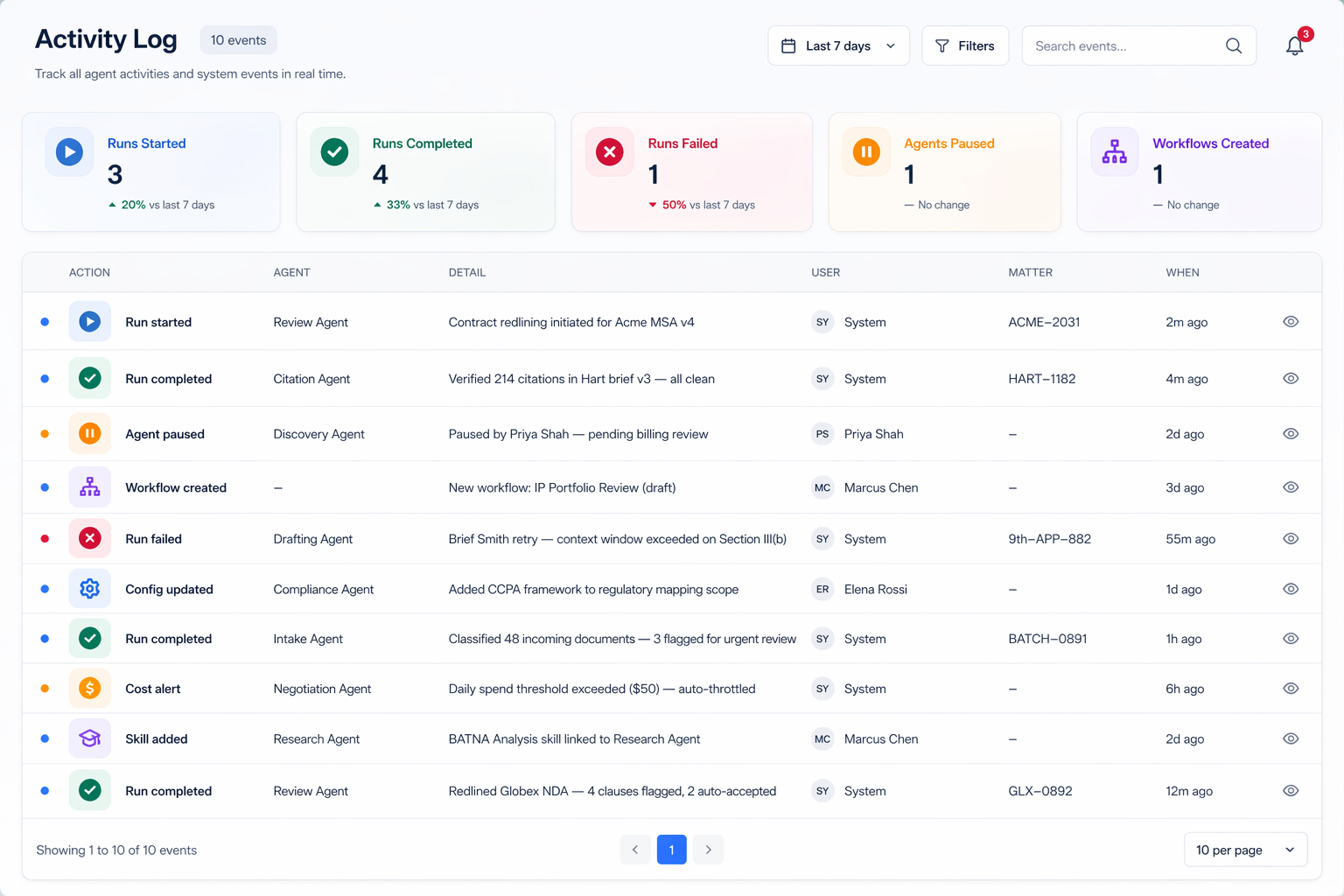
Agents are specialist roles, not chat windows. A contracts reviewer. A regulatory researcher. A deposition summariser. A compliance mapper. Each has a defined remit, access scope and way of working, closer to an associate with a practice area than to a general-purpose assistant.
Assign them to a matter, hand them a queue of work, give them a playbook to follow, and review their output the way a senior would review a junior's memo, with comments, redlines and approvals.
Complex judgment calls don't come from one voice. They come from a tense conversation between several. Panel convenes multiple specialists (a plaintiff-side advocate, a defence mind, a procedural purist, a commercial pragmatist) to debate the question you put in front of them and produce a structured, cited recommendation.
You see the disagreement, not just the conclusion. That's the point. A recommendation you can't trace is a recommendation you can't defend.
"Our strongest lever is the failure to preserve the Q2 correspondence. Lean into spoliation early; it reframes the whole discovery dispute."
"Pushing spoliation first invites a sanctions hearing they can win on negligence, not intent. Narrow the custodian list, move to compel, keep spoliation in reserve."
"Under the scheduling order you have thirty days. Either path needs a preservation letter on file this week or both are foreclosed on the record."
File preservation letter by Friday. Move to compel with a narrowed custodian list. Hold spoliation as a conditional argument pending the custodian response.
Every statement the system makes is anchored in an authority it can show you. Statutes, regulations, reported decisions, procedural rules, standing orders, bar opinions, trade instruments, accounting and tax frameworks, organised, versioned, jurisdiction-aware.
When a reasoning step relies on a source, the source is linked, dated and quoted. When it doesn't have one, it says so. A hedge you can see is infinitely more useful than a hallucination you can't.
Twenty years of closed matters, redlines, memos, research, correspondence and deal points live on a fileshare or inside someone's head. Institutional Memory turns that archive into recall. A partner's reasoning on a 2014 arbitration is surfaced the moment it becomes relevant again.
Every new matter enriches it. Every closed matter deepens it. Associates inherit the firm's experience from day one, not after a decade of osmosis.
What it recalls
Prior arguments, fallback positions, preferred clauses, client-specific redlines, and the conditions under which those choices changed are stored as retrievable memory.
How it behaves
Lawyers do not leave the workspace to search an archive. When a clause, counterparty, issue pattern or forum recurs, the relevant institutional knowledge appears in context.
Operating value
Faster
New matters inherit precedent and reasoning immediately.
Clearer
Teams see why the firm made a call, not just that it did.
Stickier
Knowledge survives departures, reorganisations and time.
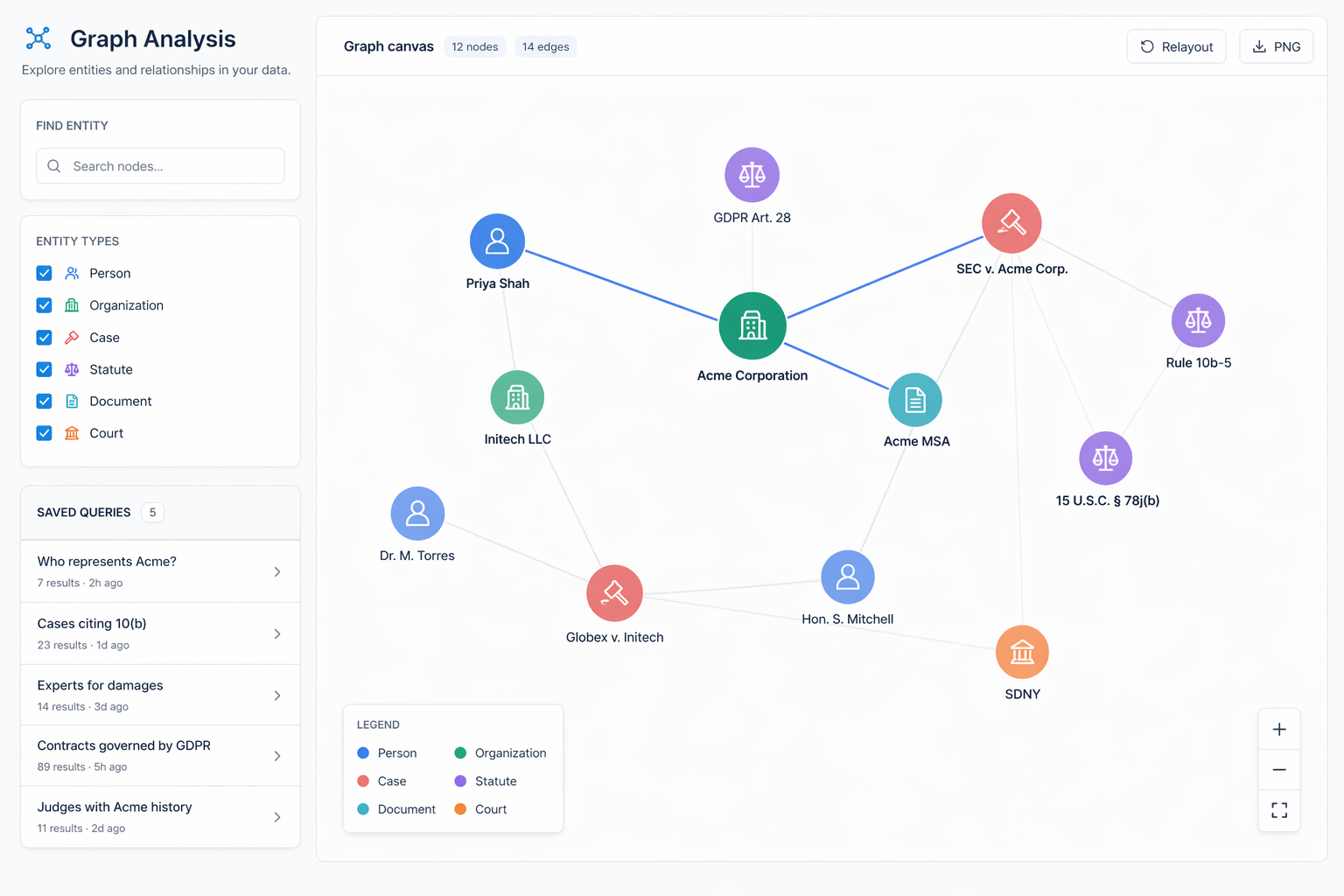
A dispute is a network: parties, entities, obligations, transactions, communications, authorities, timelines. Knowledge Graphs builds that network from the record and keeps it current as new facts come in.
Follow a chain of custody. Walk the cross-ownership web behind a counterparty. Trace a clause from master agreement through five amendments and a side letter. When a question is too complex for prose, the graph answers it.
Composition
Facts, posture, forum, appetite for risk. The matter becomes the shared context every specialist works from.
Agents, a panel, the right slice of the knowledge base and institutional memory, scoped to this matter only.
Every output is cited, reviewable and revisable. Nothing leaves the firm without human approval.
Who it serves
The same engine behaves differently depending on who uses it. Firms optimise for leverage and velocity. In-house for risk and cycle time. Litigation for strategy under uncertainty. Compliance for controls. IP for portfolio quality. Solos for coverage without overhead.
Increase partner leverage with specialist agents, reusable precedent memory, and faster first drafts that still pass senior review standards.
Compress legal turnaround while improving consistency across commercial, regulatory and governance work.
Prepare stronger litigation and investigation strategy with simulation, contradiction detection and panel reasoning before deadlines hit.
Run high-volume, high-accountability workflows with auditable controls and confidence-gated automation.
Run portfolio, prosecution, clearance and enforcement strategy from one intelligence context.
Operate with big-team depth while keeping decisions reviewable and client-ready.
How it works
A legal AI intelligence layer is a coordinated system of specialist legal models, workflows, memory, and retrieval controls that supports real legal work product. It is not just question-answering. It supports assignment, review, escalation, and final human approval in the same working surface.
Work is decomposed into roles. Each role executes within scoped context and approval policy. Results are grounded in legal authority, evaluated by confidence thresholds, and routed for review where risk is high. The outcome is structured legal output that can be defended, not just generated text.
Defensibility comes from grounded citations, explicit uncertainty handling, audit logs of model actions, and documented human approval at consequential decision points. The platform is built to support professional responsibility and client scrutiny.
Questions
No. Chatbots answer questions. The intelligence layer does work; it runs simulations, staffs agents against matter queues, convenes panels, builds graphs of the record and maintains institutional memory. Conversation is one interface. It isn't the product.
Curated primary and secondary authority, procedural and local-rule material, plus (inside your firm) your own closed matters, templates, playbooks and correspondence. Your private material stays private to your firm and never leaves your tenant.
Every substantive claim is anchored to an authority it can show you. If a claim can't be anchored, the system says so rather than inventing one. Reviewers see the cite chain on every material sentence; uncited assertions are flagged for human judgment.
General assistants are generalists. The intelligence layer is a system of legal specialists with scoped roles, bounded authority, matter-aware context, citation discipline and reviewable work product. It's engineered around how lawyers actually assign, review and sign off on work.
Judgment, strategy, client relationships, filings, signatures and anything that crosses the bar of professional responsibility. Nothing leaves the firm without a human approval step. The layer compresses preparation; it doesn't replace counsel.
Yes, and that's where institutional memory earns its keep. Closed matters, partner redlines, deal points and internal research become recall that serves the next matter. Scopes and permissions follow your existing ethical walls.
Coverage is deep where our customers work and expanding. Core common-law and civil-law jurisdictions are supported; specialised forums (arbitral, regulatory, administrative) are configured per engagement. We'll tell you honestly where coverage is thin before you rely on it.
Simulations are framed as rehearsal, not prediction. Outputs surface ranges and assumptions, not point estimates. Where the record is thin or the forum is unpredictable, the simulation says so and shows what additional facts would tighten the range.
Yes. That's the whole point. A panel whose specialists always agree is a synonym generator. Disagreement is preserved, surfaced and attributed so that the final recommendation is defensible on its reasoning, not just on its conclusion.
Yes. Most teams start by connecting document repositories, matter data and playbook sources so agents and simulations can operate on current, governed context. Rollout can start in one workflow and expand in phases.
Teams track cycle-time reduction, review throughput, first-pass quality, escalation rates, and matter outcomes. We baseline current process time and quality, then compare the same workflow after deployment.
Yes. Audit trails, approval gates, scoped permissions, and governance controls are built into workflow execution. The platform is designed for defensible legal operations, not just faster drafting.
Most firms start with a single practice or a single workflow: a class of contracts, a docket, a deposition programme. We configure the bench for that use, measure the lift against a baseline, and expand from there.