Solution · AmLaw Firms
The intelligence layer
for firms that set the standard.
Reasoning and drafting built for AmLaw 100 and 200 practices. Ethical walls by default. Institutional Memory across partnerships. Capacity that scales with the practice, not headcount.
At scale
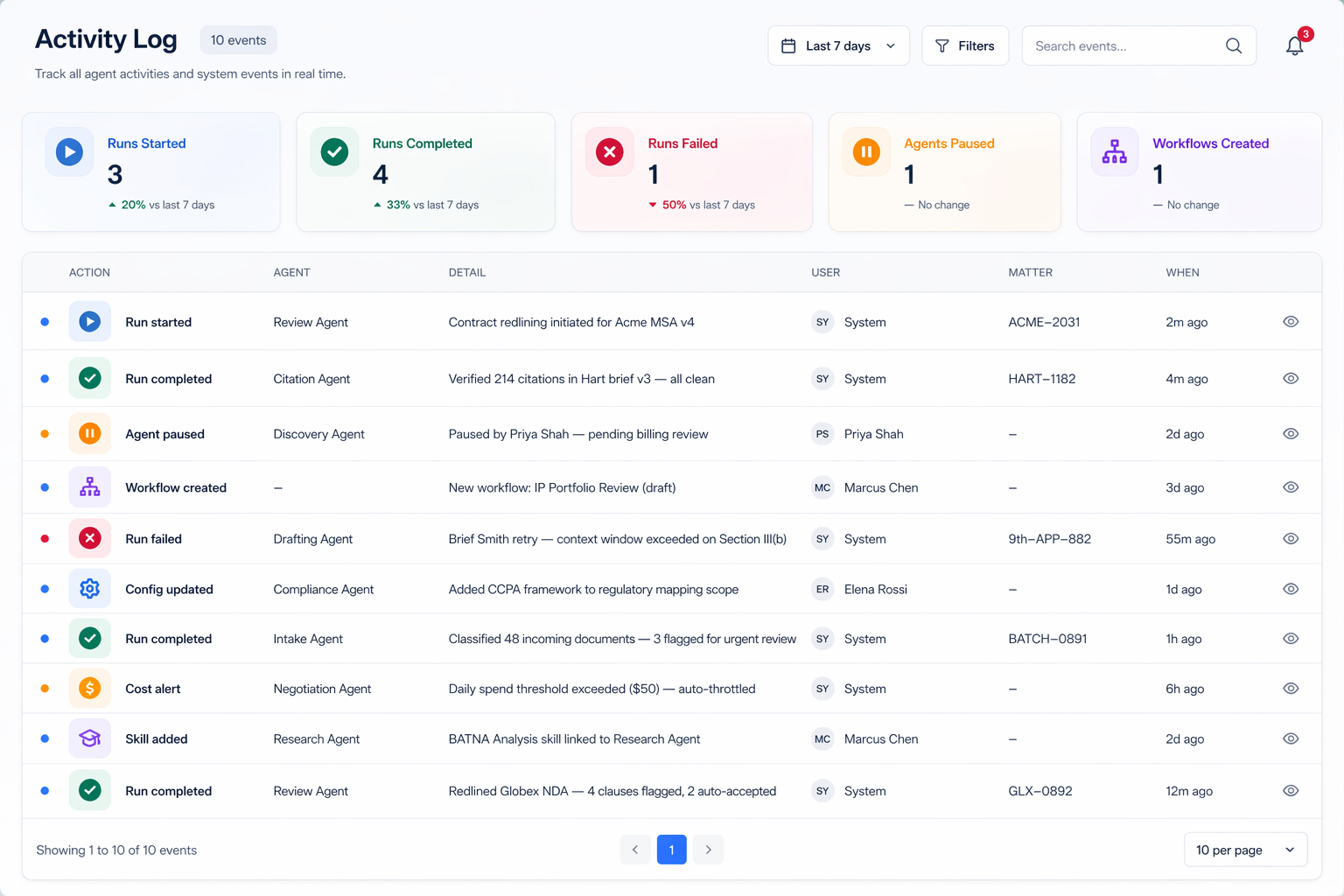
At AmLaw scale, AI isn't a tool. It's an operating decision.
Large firms don't need another associate-facing chatbot. They need a layer that works the way the firm works: across practice groups, ethical walls, global offices, and decades of institutional knowledge. Governance as a first-class concern, not an add-on.
Architected for firm-wide deployment from day one. Integrates with the DMS, CLM, conflicts, billing, and matter systems you already run. Honours the ethical walls you already maintain. Turns closed matters, templates, and precedent into an asset for the next matter.
Who this is for
Built for the firm, not just the user.
Leverage, quality control, and matter profitability across practice groups, with partner-level visibility on AI-assisted work product.
Case theory, simulation, discovery, deposition prep and brief drafting at the scale of complex multi-party litigation.
Due diligence, transaction management, contract review and playbook-driven drafting across deal pipelines.
Enforcement response, internal investigations, regulatory mapping and multi-jurisdiction compliance analysis.
Prosecution, opposition, portfolio strategy and licensing diligence across a global IP footprint.
CIO, COO, risk and information governance teams managing firm-wide AI deployment, ethics walls and vendor risk.
One reasoning layer. Every practice group.
Litigation, corporate, regulatory and IP teams each have their own language, but they share a client base and a firm. JudicialMind delivers a single intelligence layer with practice-specific configurations. A litigation associate and a corporate associate both get expert-grade outputs without the firm maintaining separate AI stacks.
Cross-practice work (regulated M&A, IP litigation, cross-border investigations) operates on a shared surface with scoped permissions.
- Practice-specific agent configurations (litigation, corporate, regulatory, IP)
- Cross-practice matter surfaces with scoped access
- Unified governance and audit across groups
- Central vs. group-level playbook management
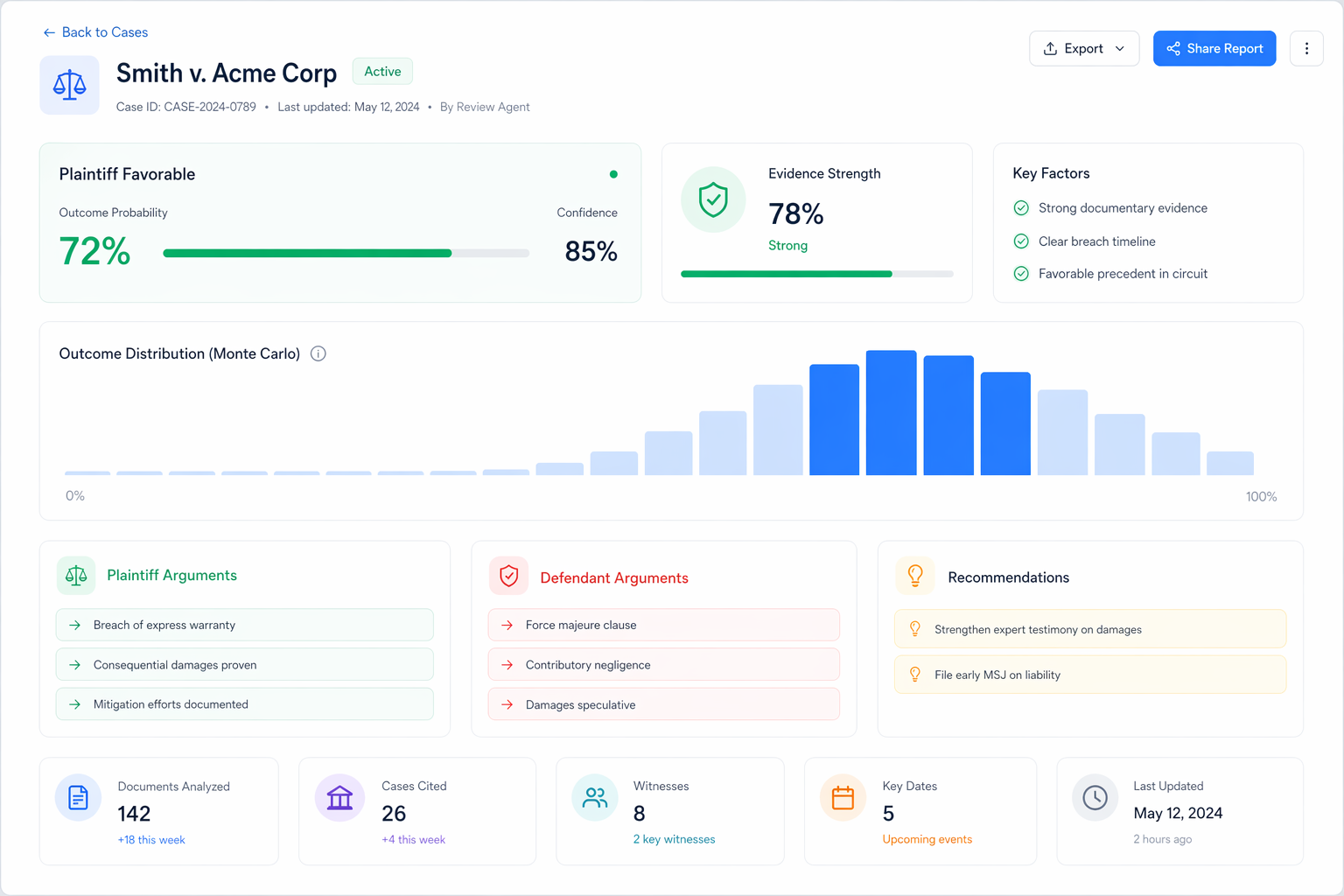
The firm's 40 years of work, working for every associate.
Closed matters, partner redlines, precedent opinions, winning briefs, and deal points are the firm's most valuable asset, and its most under-utilised. JudicialMind turns them into active recall that serves the next matter, scoped by ethical wall and client permission.
When a third-year pulls a draft, they get the partner's last five variants on that exact provision. Not a generic template.
- Closed-matter recall with ethical-wall scoping
- Precedent and template retrieval across practice groups
- Partner-authored edits preserved and surfaced on new matters
- Knowledge-management layer that maintains itself
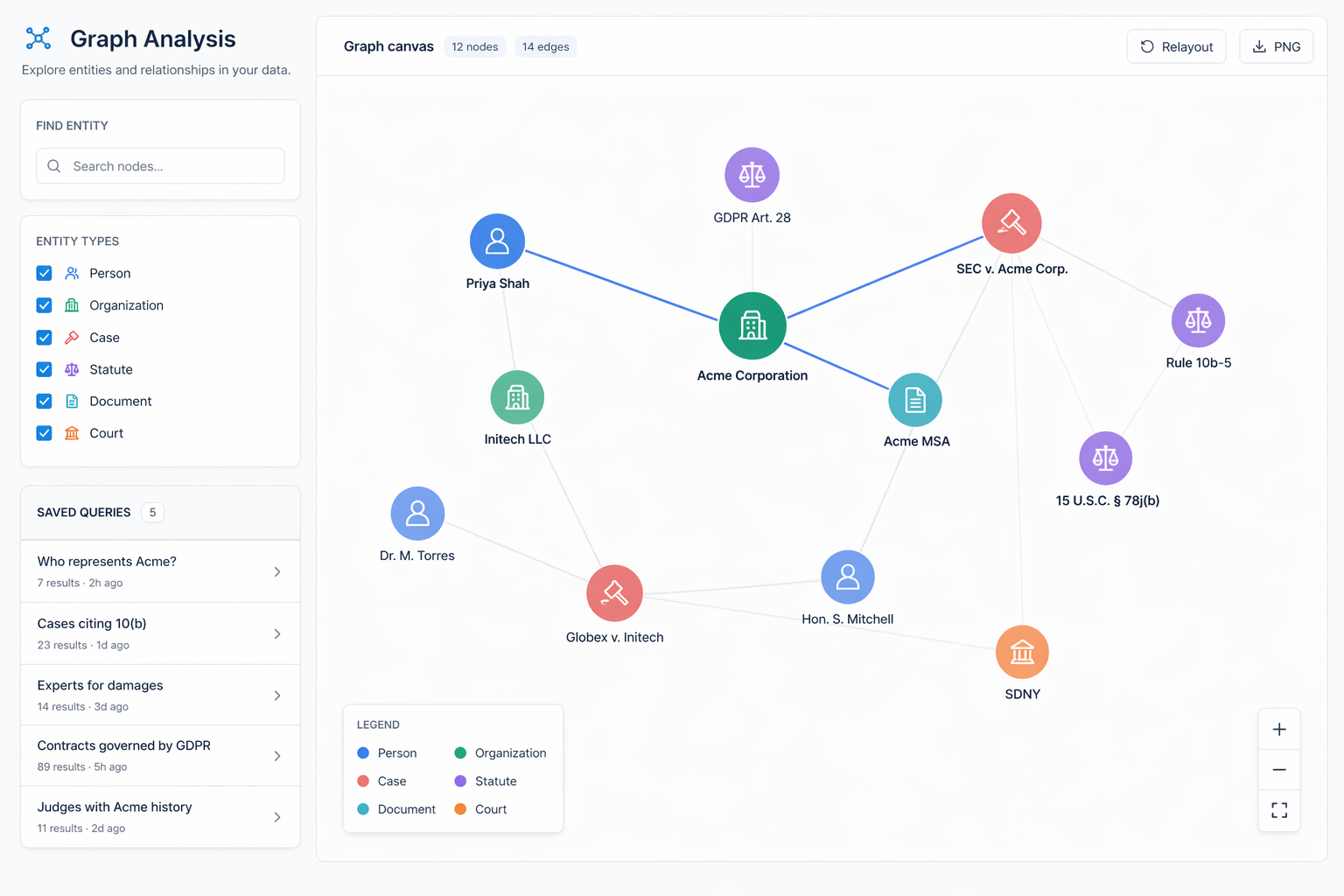
The firm's governance, enforced by the platform.
Ethical walls aren't an afterthought; they're the architecture. Every retrieval, generation and matter interaction respects the firm's conflicts-and-walls configuration. Access scopes mirror matter permissions. Nothing crosses a wall via the AI that wouldn't cross it via the DMS.
Audit trails on every material output support both ethics-wall maintenance and downstream review.
- Conflicts and ethical-wall enforcement on retrieval and generation
- Matter-scoped access with role-based permissions
- Full audit log of prompts, retrievals, generations and approvals
- Client-specific data-handling and residency support
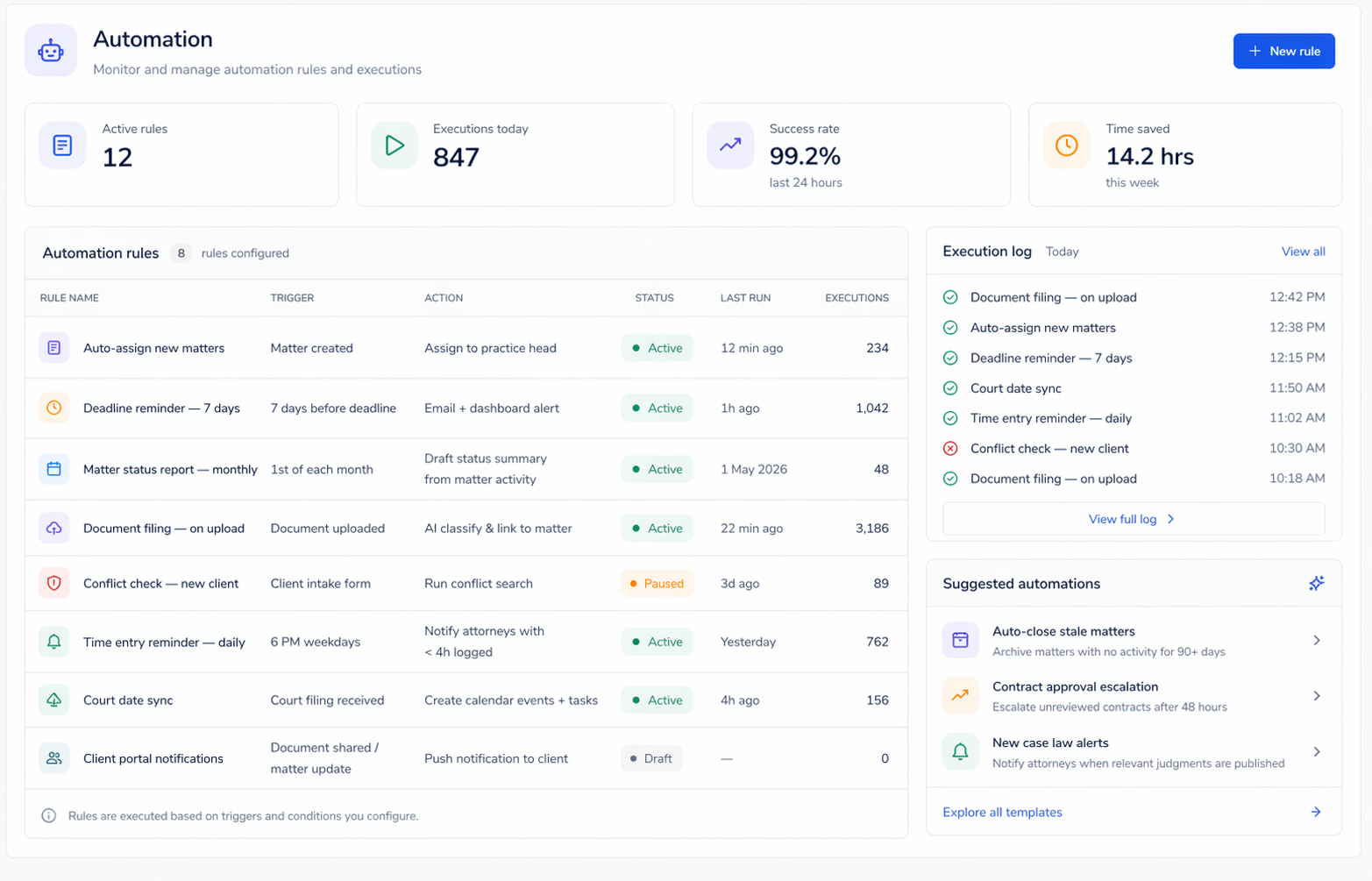
Fixed-fee work that actually holds its margin.
The economic pressure on large firms is real: clients want fixed fees and AFAs, associates are harder to keep, and quality standards haven't moved. JudicialMind lifts effective leverage without adding headcount. A second-year produces work the partner is willing to sign.
Practice leaders see matter-level profitability shifts; partners see quality they actually trust; clients see budget discipline.
- Higher effective associate leverage on matter teams
- AFA and fixed-fee matters that hold their margin
- Partner-level visibility on AI-assisted deliverables
- Matter-profitability views aligned to billing systems
What changes
What changes when an AmLaw firm runs on JudicialMind.
Reduction in first-draft cycle time across litigation, corporate and regulatory workstreams.
Effective associate leverage on matters without compromising partner review standards.
Audit trail on AI-assisted work product. Ethics walls enforced at the platform layer.
-wide institutional memory replacing knowledge-management efforts that never quite stuck.
Figures reflect typical ranges observed across deployments; actual results depend on matter mix, team maturity and rollout scope. We baseline and measure against your current process, not a marketing average.
How it's built
Composed from the JudicialMind platform.
This solution is assembled from the same product layers every JudicialMind customer runs on. You get the full depth of the platform, tuned to a specific practice profile.
Case simulation, specialist agents, panels and grounded research for every practice group.
Matters, playbooks and automation with firm-wide governance built in.
Patent, trademark and portfolio workflows for IP groups at AmLaw scale.
Contentious-matter workflows across litigation, arbitration and enforcement.
Questions we get
Frequently asked.
Yes. Standard integrations exist for the major DMS, CLM, conflicts and practice-management platforms AmLaw firms run. Enterprise onboarding builds bespoke integrations where needed, with firm IT owning the trust boundary.
Ethical walls are enforced at the retrieval and generation layer, not just in the UI. The AI can't surface, reference or incorporate material on the other side of a wall. Wall configuration mirrors the firm's existing conflicts system.
In the firm's dedicated tenant. It is not used to train shared models. Data residency can be configured to specific regions for cross-border practices and client mandates.
Many clients now specify AI-use requirements in outside-counsel guidelines. JudicialMind supports client-scoped policies (data handling, model use, disclosure, and retention) enforced on the matters governed by those guidelines.
Those are features. This is a reasoning layer. Point features answer narrow questions; an intelligence layer runs multi-step legal work (simulation, drafting, investigation, panels) with governance and Institutional Memory. They coexist. JudicialMind is the tier above.
The platform is designed to meet partners where the work is: reviewable drafts, audit trails, no prompting required. Adoption patterns at AmLaw firms typically go through matter teams first; partners engage through review, not through prompting.
AI-assisted time is captured at the matter surface and maps to existing billing systems. Firms control how AI-assisted work is disclosed to clients and how it is billed under AFA or hourly structures.
Typical AmLaw rollouts run in phases: a pilot practice group first, then expansion, over a three- to nine-month timeline depending on scope, integrations, and governance requirements. We scope against your firm's change-management appetite, not a marketing timeline.
Meet the firm's scale. Without changing how the firm works.
Already deployed with partners and practice leaders across large firms. Talk to our enterprise team and we'll walk through architecture, governance, and a staged rollout for your firm.