Home

The Workspace

One workspace for all legal work.

Matters, contracts, playbooks, drafting, review, research, and automation on one record. Agents draft and review inside the matter. Deadlines, obligations, and approvals stay connected.

One surface

One surface. One record. One team.

Most legal software assumes the work is the artefact: a contract, a pleading, a checklist. We assume the work is the matter: the living engagement that threads people, documents, deadlines, correspondence, authorities, and decisions into one narrative.

The Workspace is that narrative made operable. Every module is a lens onto the same record. Switching tabs isn't switching tools; it's changing how you see the matter you're already in.

The matter is the spine.

A matter is more than a folder. It's the parties, the posture, the budget, the team, the timeline, the open questions, the next three deadlines and the partner's working theory, all visible at a glance and always in sync.

Client updates become a one-click export. Staffing shifts surface the knock-on effects. Budget drift is visible before it's a conversation. Everything downstream (drafting, review, research) inherits this context automatically.

  • Structured matter intake and lifecycle states
  • Deadlines, tasks and obligations in one clock
  • Budget, billing and realisation in context
  • Client-ready status snapshots on demand
Matter overview with parties, timeline, deadlines and team
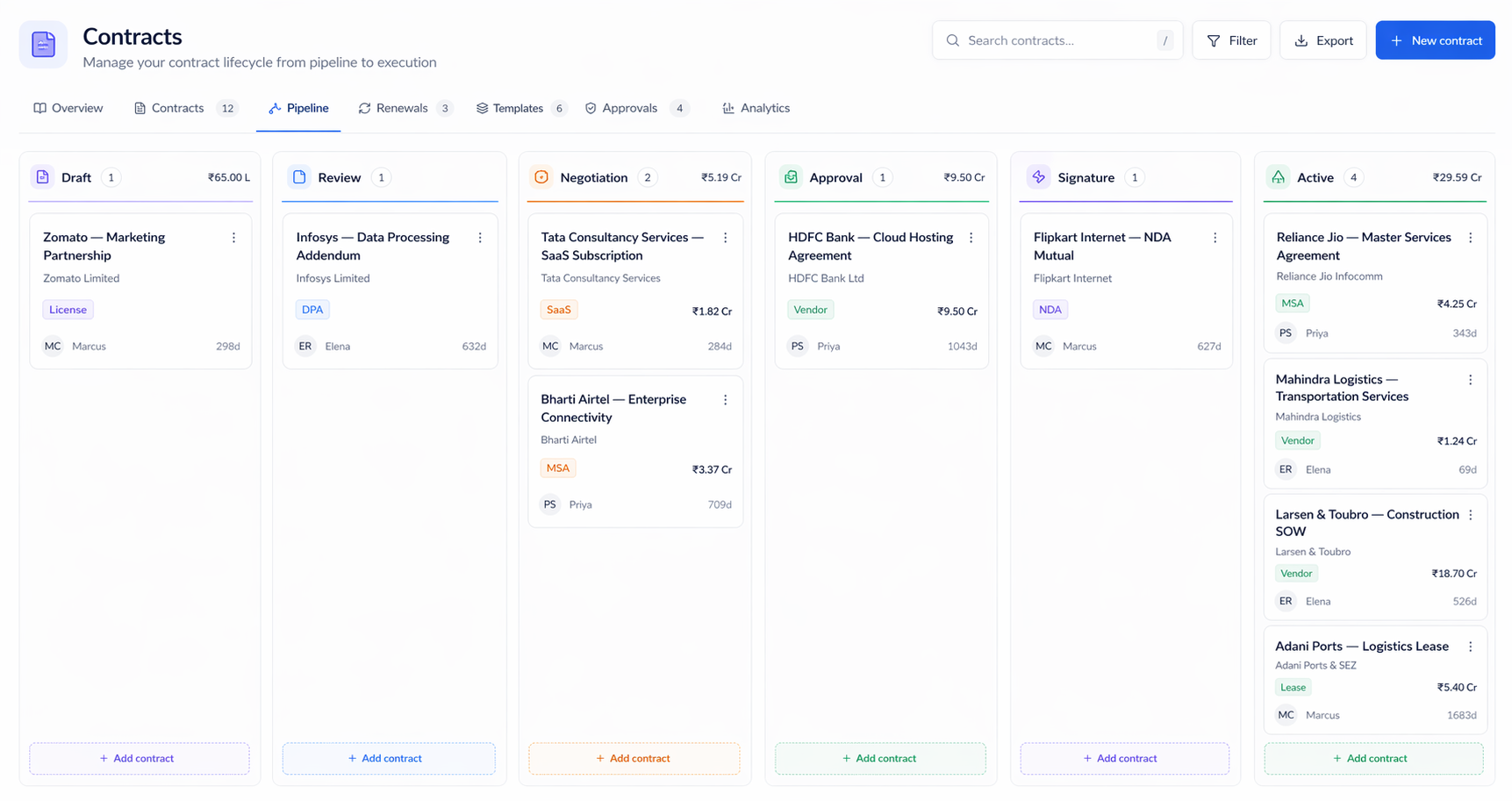
Contract lifecycle management with redline, risk and obligation tracking

Redline, risk, obligation: one loop.

Draft from a living playbook. Redline against your firm's positions, not a generic standard. See every deviation from policy in the margin, rated for risk and linked to the precedent that justifies it. Obligations extracted at execution flow automatically into the calendar and the matter.

Renewals, breaches and amendments don't get rediscovered three years later in an audit; they surface when they're still useful.

  • Playbook-driven redlining with risk scoring
  • Clause library and position history
  • Obligation extraction and downstream tracking
  • Amendment and renewal intelligence

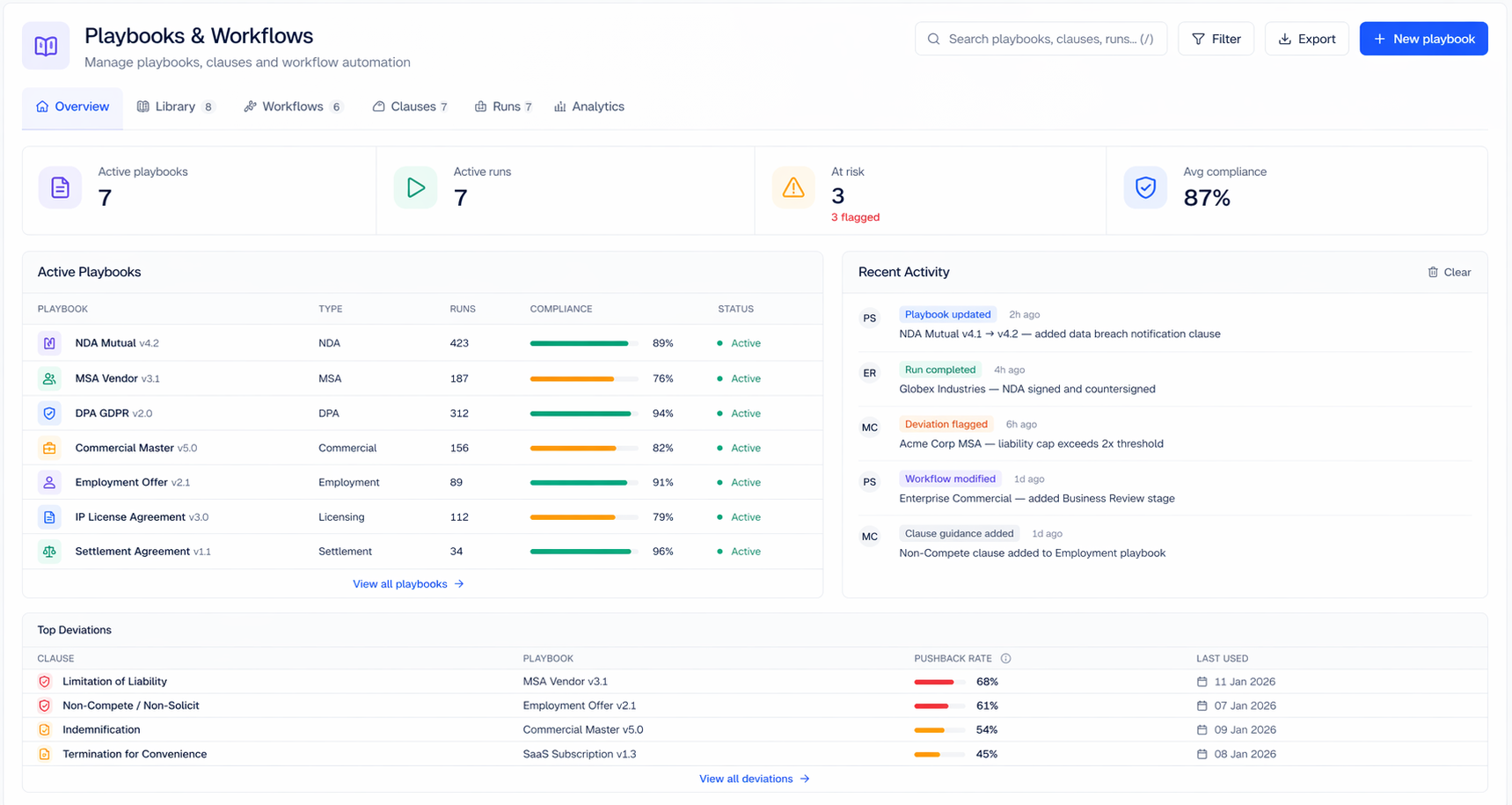
Your firm's positions, made executable.

Every firm has positions. Few have them written down. Fewer still have them enforced consistently across associates, clients, deals and time. Playbooks captures what "we always" and "we never" actually look like: preferred clauses, fallback positions, walk-away points, rationale, exceptions - and threads them into every workflow that needs them.

New associates inherit the firm's muscle memory on day one. Partners spend review cycles on judgment calls, not on reteaching the same position.

Playbook editor with preferred positions, fallbacks and rationale
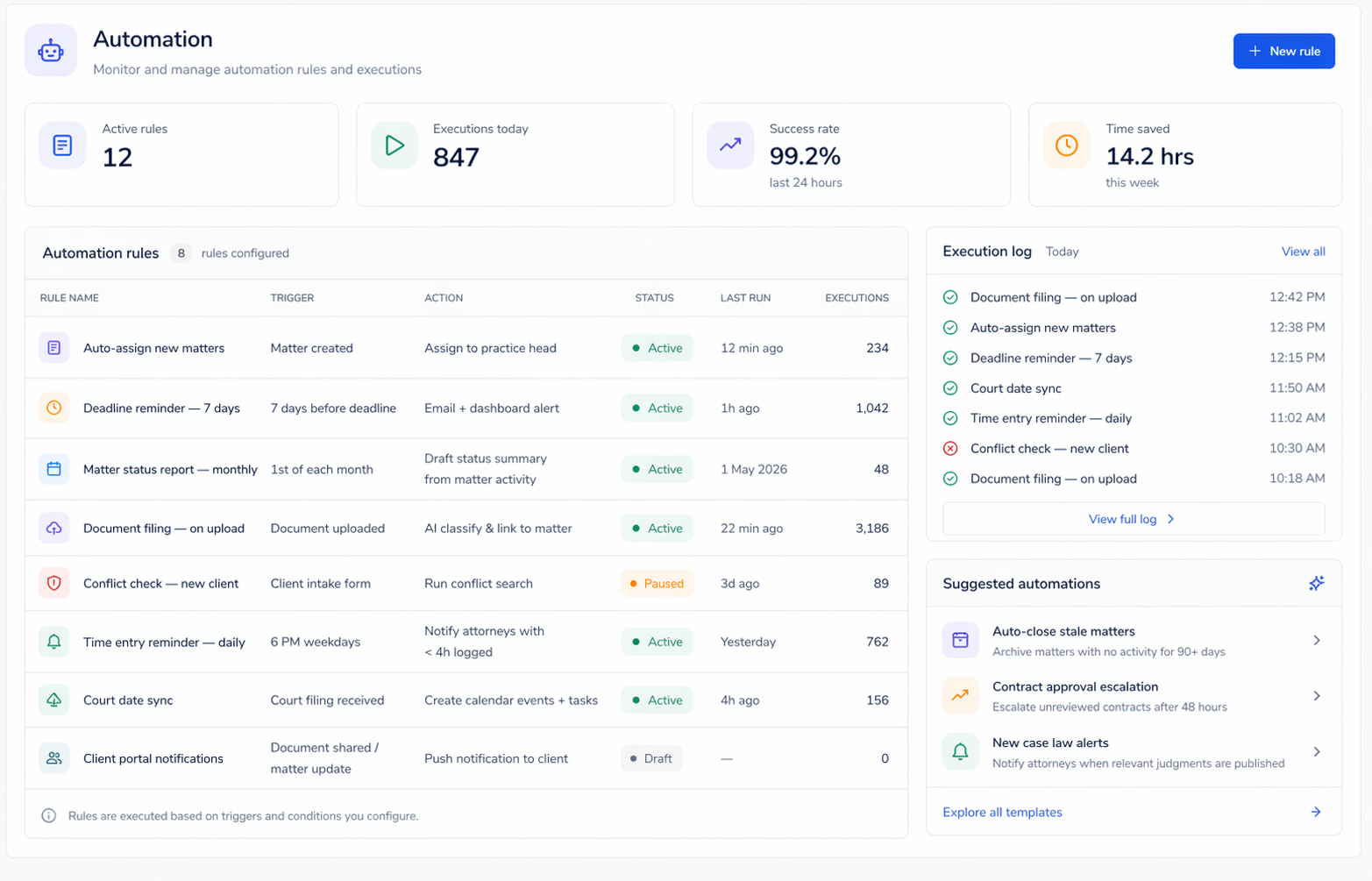
Automation workflow routing tasks between reviewers, agents and approvers

The work that moves itself.

Intake, triage, assignment, escalation, reminders, approvals, closing checklists. The machinery of practice. Automation gives you a place to design those flows so humans do the parts that need humans and agents handle the parts that don't.

Every step is auditable. Every handoff is explicit. Every exception lands on a desk that's expecting it, not in a shared inbox at 6pm on a Friday.

  • Visual flow design with human and agent steps
  • SLA tracking, escalation and audit trails
  • Native hooks into documents and matters
  • Reusable, versioned, shareable

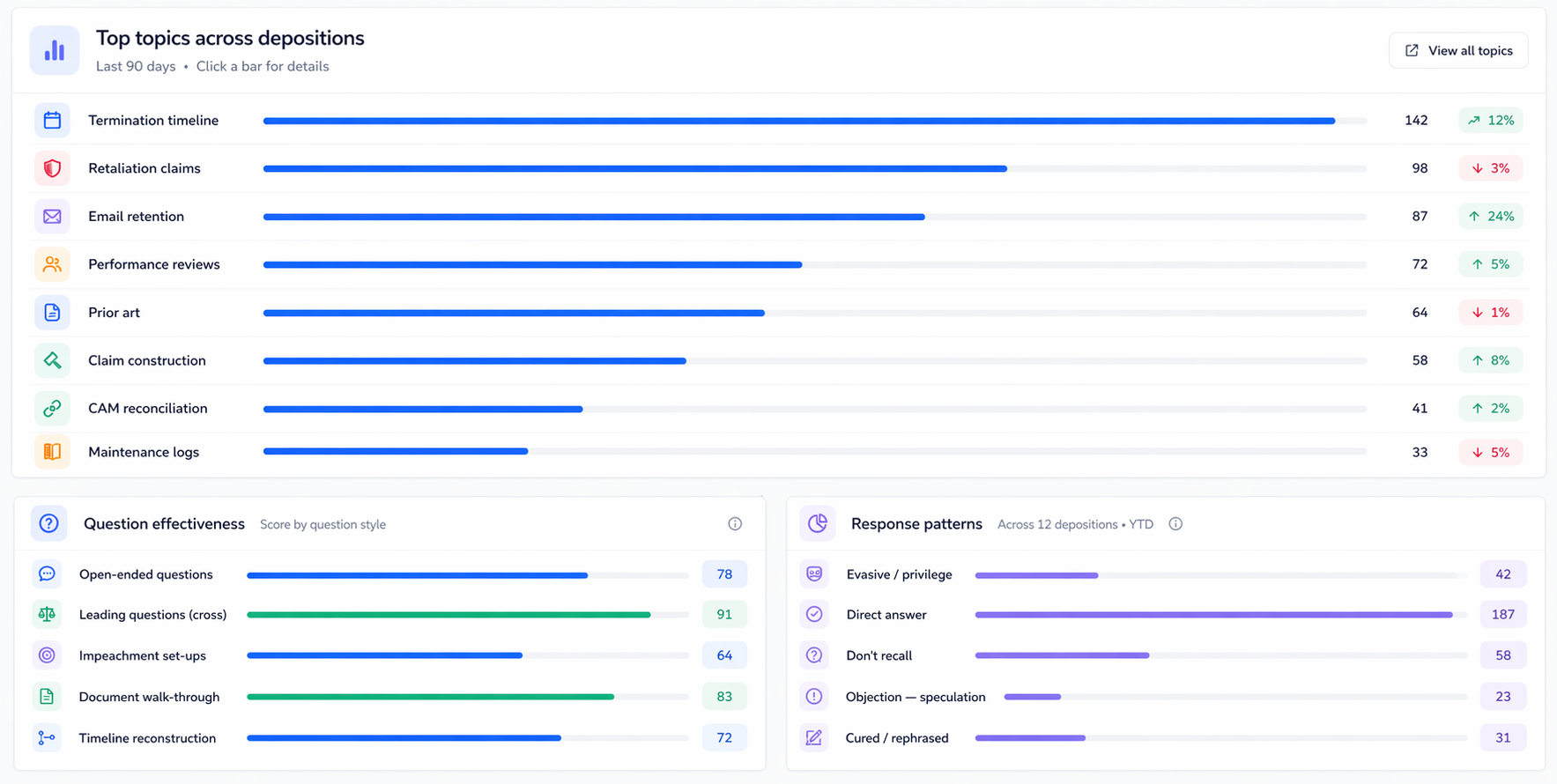
Outlines, exhibits, impeachment. Ready.

The record gets absorbed. Prior statements are cross-indexed. Impeachment material surfaces the moment a witness drifts from their last sworn answer. Outlines draft themselves from the theory of the case, then get sharpened by the lawyer who'll actually take the chair.

Then you rehearse against a Panel that plays opposing counsel until the weak questions are the ones you want to ask on the day.

  • Theory-driven outline generation
  • Prior-statement cross-indexing and impeachment prompts
  • Exhibit packets, live and portable
  • Mock-cross rehearsal with the intelligence layer
Deposition preparation workspace with outline, exhibits and cross-reference

More in the workspace

The quieter machinery that carries the day.

Tabular Review

Turn a document population into a spreadsheet of answers. Ask one question across ten thousand agreements, review the rows where it matters, export what the partner asked for.

Drafting

Write inside a document that knows the matter, the playbook and the authority. Suggestions arrive in the margin, not in a separate tab. Every insertion carries a cite.

Legal Research

Ask the question, get a memo that stands up to scrutiny. Primary authority, procedural rules and practitioner commentary braided into a single, reviewable answer.

Document Management

Versioning, permissions, ethical walls and search that actually finds the paragraph you remembered. A record lawyers can defend, not a rebranded fileshare.

Calendar & Tasks

Deadlines computed from the rules that govern them. Tasks that carry context. Notifications that know the difference between urgent and loud.

Analytics

Throughput, realisation, cycle time, risk exposure, playbook compliance. The numbers you need for a practice review without a month of BD work.

Who it serves

One legal workspace, different operating realities.

Firms need leverage, utilisation visibility, and repeatable work product. In-house teams need faster turnaround and clearer risk posture. Legal operations needs structure, reporting, and automation. Practice groups need local nuance without losing firm-wide standards.

Law firms

Run matters, drafting, billing, playbooks and client communication from one place that supports partner review and associate execution.

  • Matter-aware drafting and research
  • Utilisation, realization and workflow visibility
  • Institutional memory captured across teams

In-house legal

Move commercial and governance work faster while preserving approval logic, obligations and audit trails.

  • Contract lifecycle visibility end to end
  • Policy-to-workflow alignment
  • Outside counsel spend reduction through insourcing

Legal operations

Build a governed system of record for legal intake, process, reporting, workload and automation.

  • Role-based reporting and dashboards
  • Queue, SLA and automation design
  • Cross-module orchestration without tool sprawl

Practice groups

Support contracts, disputes, compliance, IP and corporate work from a shared workspace without flattening specialist needs.

  • Practice-specific playbooks and templates
  • Shared matter context across modules
  • Consistent review and handoff workflows

How it works

What a legal workspace means in practice.

What is legal workspace software?

Legal workspace software is the operating layer where matters, contracts, drafting, tasks, communication, analytics and automation share the same context. It replaces point-solution switching with a single governed surface for legal work.

How is JudicialMind different from a bundle of legal tools?

Most stacks connect separate systems after the fact. JudicialMind starts from one record and lets modules behave like views onto that record. Contracts, research, billing, drafting, review and analytics are not synced copies. They are different working surfaces on the same matter-aware data.

What problems does the workspace solve?

  • Fragmented tools and costly context switching
  • Missed deadlines and weak handoffs between teams
  • Lost revenue from untracked time and poor visibility
  • Inconsistent drafting, review and playbook compliance
  • Limited reporting on legal throughput and risk

How does the workspace stay defensible?

Permissions, ethical walls, audit trails, matter context, deadline logic and approval workflows are embedded in the operating model. The result is a workspace that speeds work up without making it harder to supervise, defend or report.

Questions

Before the rollout.

No, though many firms eventually do. JudicialMind is designed to live beside the tools you have today, pulling from them and pushing back to them. Most customers consolidate over time because the workspace removes the reason their old tools existed in parallel.

A single practice group can be live on a focused workflow (a contract class, a docket, a deposition programme) within a few weeks. Firm-wide rollout is scoped to your pace. We don't do big-bang migrations and we don't push you into one.

Matter-level isolation, client-level isolation and firm-level isolation are first-class. Ethical walls configured in the matter are honoured by every module, including the intelligence layer. Audit logs are complete and exportable.

They come with you. Templates are imported, tagged and versioned. Playbooks are captured (often for the first time) from the partners who carry them in their heads. Precedent archives feed institutional memory and become recallable across new matters.

Seat-based for the workspace; usage-based for intelligence-heavy workloads where it genuinely tracks value. We price for deployment, not for experimentation, and we publish an honest ceiling so finance can model it.

No. Your matter data stays within your tenant and is never used to train any model outside your firm. Institutional memory is trained on your data for your use only.

They do when the workspace removes work they didn't want to do in the first place. The pattern is consistent: the tools lawyers complain about going back to are the old ones, not the new one.

Bring them in as-is. The system ingests the existing record, reconstructs the timeline, surfaces the open questions and lets you keep working. You don't freeze the practice to migrate.

Cycle time on defined workflows, realisation on fixed-fee work, volume cleared per associate, playbook compliance, and (for in-house teams) reduction in outside counsel spend on the workstreams the workspace owns. We baseline with you before rollout.

Enterprise controls, regional data residency, configurable retention, detailed audit, SSO and role-based access. Our security documentation is available under NDA and updated continuously; we'd rather show it than summarise it.

JudicialMind Workspace is an AI-native legal operating system that brings matters, contracts, drafting, review, calendar, analytics and automation into one shared surface. It replaces fragmented toolchains with a single governed record of work.

Instead of moving between separate systems for contracts, research, billing, deadlines and client communication, teams work from one matter-aware environment. That means less context loss, fewer duplicate updates, and better downstream automation.

Move one workflow. The rest will want to follow.